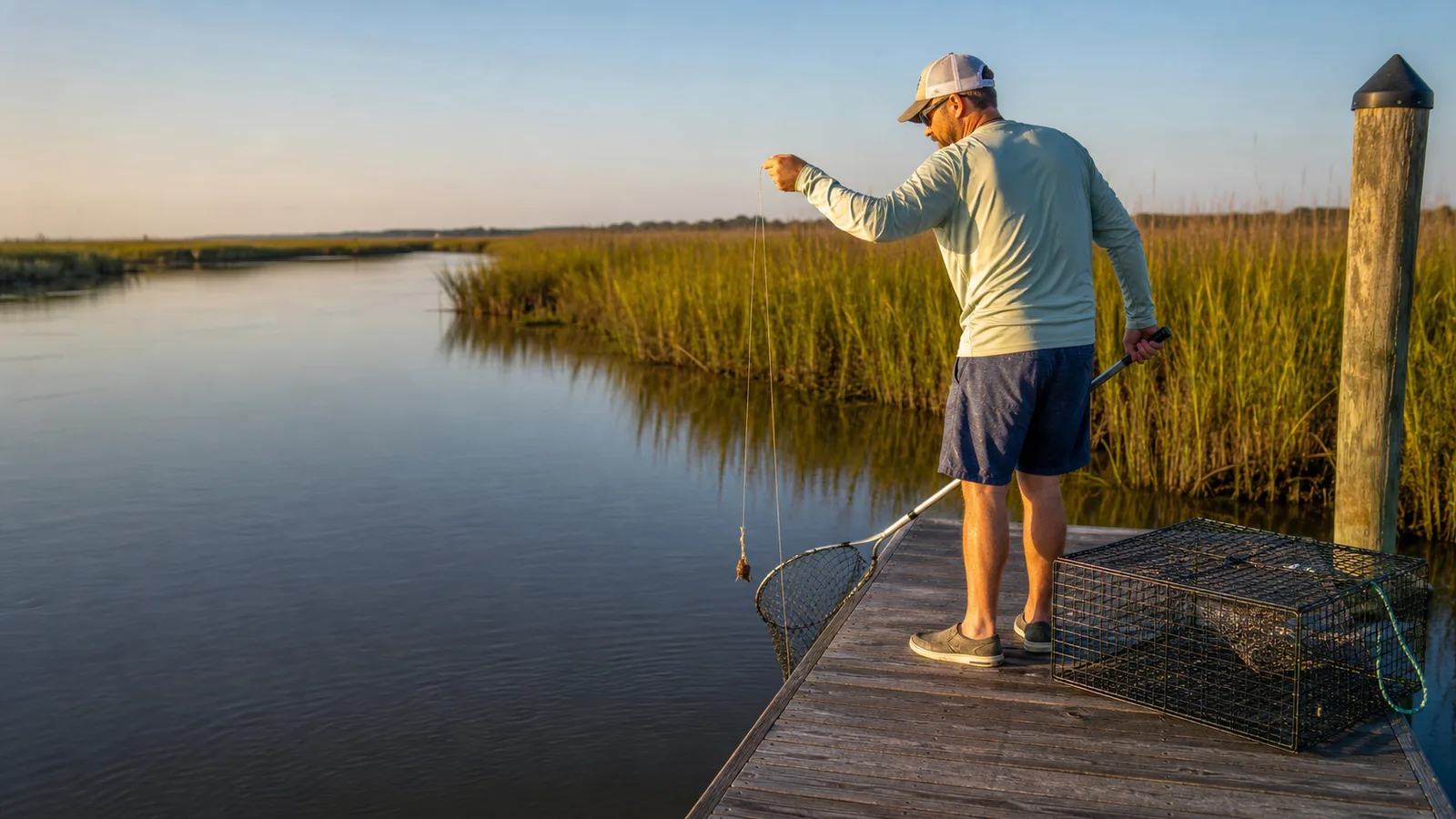
Crabber working a hand line with a dip net beside a recreational crab trap on a Northeast Florida dock

First Coast Crabbing Guide

Blue crabs, stone crabs, and more.

Learn the simple hand-line method, set a legal recreational trap, identify the local catch, and know the rules before you go.

Before You Go

License and trap registration

1

Fishing license

A Florida saltwater fishing license is generally required to take saltwater crabs. A shoreline-only license applies only from shore or a structure fixed to shore—not from a boat, a shore reached by boat, swimming, or diving. Check exemptions before harvesting.

2

Free trap registration

Anyone age 16 or older using a standard blue crab or stone crab trap must also complete the matching no-cost annual registration—even if normally exempt from a fishing license. Blue-crab numbers begin with “B” and stone-crab numbers with “S.”

3

Mark every trap

Permanently and legibly attach the owner’s full name, address, and FWC registration number. A buoy must be at least 6 inches and display an “R” at least 2 inches high. Dock-fished traps do not require a buoy.

Two Easy Approaches

Crabbing by hand line or trap

Best for docks and creek banks

Blue crabs by hand line

  1. Tie chicken necks, fish scraps, or other durable bait to a cord. Use only lawful bait and do not leave scraps behind.
  2. Lower it to the bottom near marsh edges, pilings, or a creek drop-off during moving water.
  3. When the line grows heavy or begins to move, retrieve it very slowly. Keep steady tension.
  4. Slide a long-handled dip net behind and beneath the feeding crab before lifting it from the water.
  5. Use gloves or long tongs, confirm no eggs are attached, and place legal crabs in a shaded, ventilated container.

Why it works: Hook-and-line gear and dip or landing nets are legal for blue crab, and no trap registration is needed when no standard trap is used.

Best for soaking over moving tides

Blue and stone crab traps

  1. Use the correct trap for the species; blue-crab and stone-crab traps have different throat, mesh, escape-ring, and degradable-panel specifications.
  2. Secure bait inside the trap. Oily fish such as legal carcasses or heads hold scent well.
  3. Set outside marked navigation channels where the line and buoy will not endanger boats, swimmers, or wildlife.
  4. Pull recreational traps manually and only during daylight. Mechanical trap pullers require commercial credentials, except qualifying ADA accommodation.
  5. Check traps regularly, release prohibited catch immediately, and retrieve every trap before a closure or storm.

Never touch someone else’s gear: Tampering with another person’s trap, line, buoy, or catch is illegal—even if it appears abandoned.

Recreational Trap Checklist

Blue-crab and stone-crab traps are not interchangeable

RequirementBlue crab trapStone crab trap
Maximum number5 per person5 per person
Maximum size2 × 2 × 2 feet or 8 cubic feet24 × 24 × 24 inches or 8 cubic feet
Entrance / throatRigid throat no larger than 2 inches high × 6 inches wide at its narrowest point; may extend no more than 6 inches insideNo larger than 5½ × 3½ inches; a round entrance may not exceed 5 inches in diameter
Mesh / escapeMesh at least 1½ inches; at least three escape rings of 2⅜ inches or largerWire traps: three unobstructed 2⅜-inch rings. Wood/plastic traps: one unobstructed 2³⁄₁₆-inch ring in a vertical exterior wall
Degradable panelRequired; opening must be larger than 3 × 6 inches and use an approved degradable materialRequired 5½ × 3½-inch cypress or untreated-pine panel, no thicker than ¾ inch
Owner markingName, address, and annual “B” registration numberName, address, and annual “S” registration number
BuoyAt least 6 inches with a 2-inch “R”; not required from a dockAt least 6 inches with a 2-inch “R”; not required from a dock

This is a field summary, not the complete rule text. Verify your exact trap against the current FWC diagram before setting it.

Identification & Harvest

Crabs found around Northeast Florida

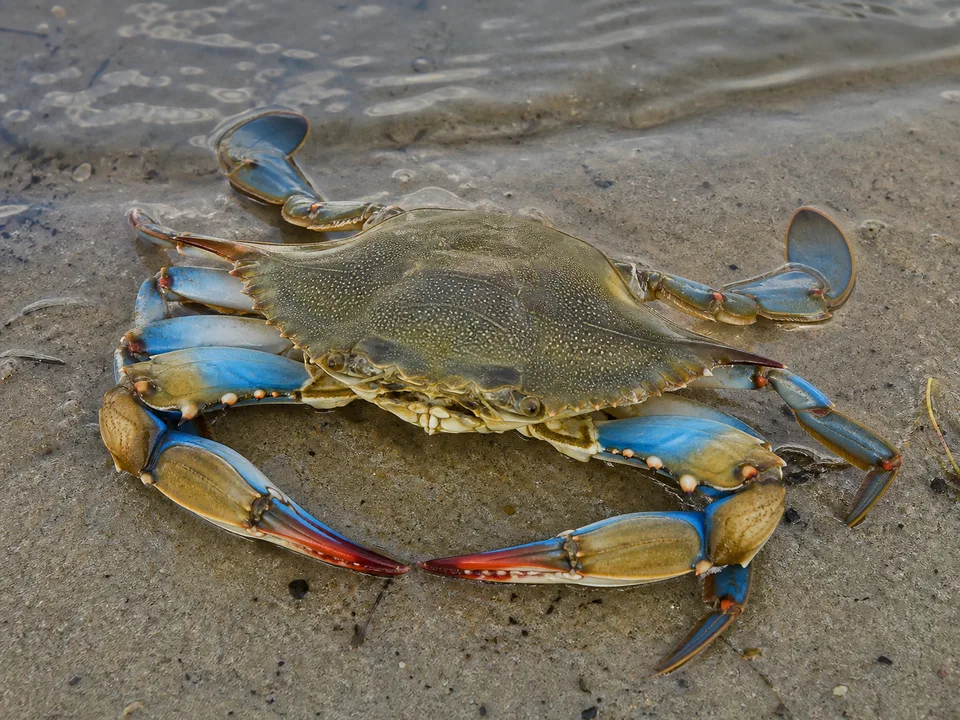
Adult Atlantic blue crab showing its blue claws and paddle-shaped rear legs

Callinectes sapidus

Atlantic blue crab

Our familiar estuary crab. Look for a broad olive shell with a long side spine, blue legs and claws, and flattened paddle-shaped rear legs. Found in tidal creeks, rivers, marshes, docks, and bays.

Size
No recreational minimum
Daily limit
10 gallons whole per harvester
Season
Open year-round except regional standard-trap closures
Eggs
Egg-bearing crabs may not be harvested
Legal gear
Up to 5 standard traps, dip/landing net, drop net, fold-up trap, hook and line, push scrape, or trotline. Crab snares are not legal.
2026 First Coast trap closures St. Johns River system: Jan. 16–25. Georgia line through Volusia County, excluding the St. Johns system: Aug. 20–29. These closures apply to standard blue-crab traps. Other legal gear and traps attached to private property such as a dock are exempt.
Check current FWC blue crab rules →
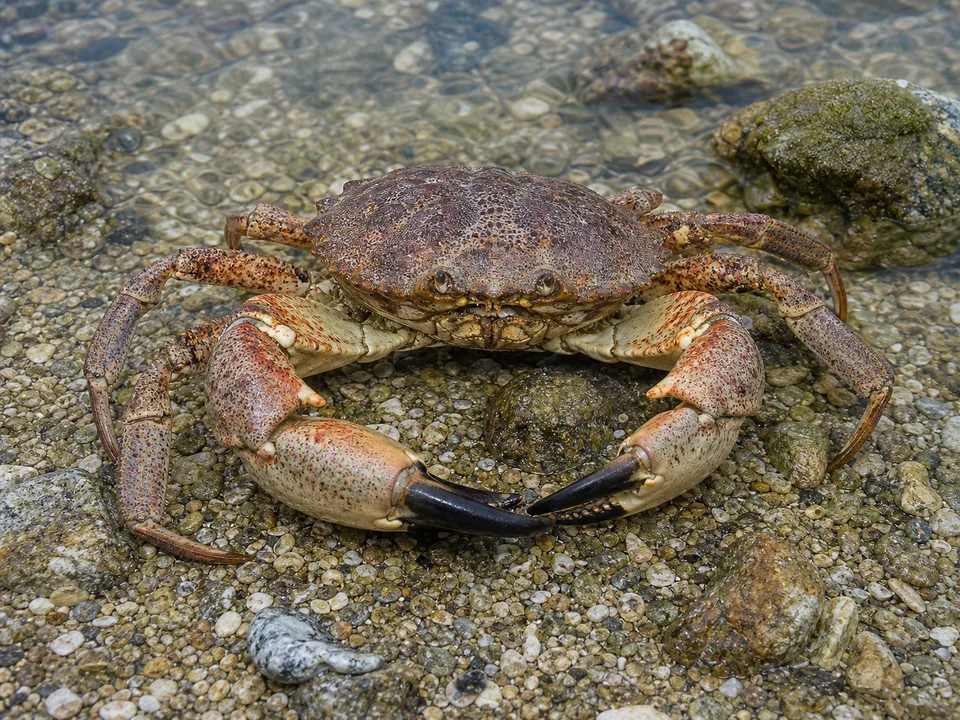
Adult Florida stone crab showing its heavy black-tipped claws

Menippe mercenaria

Florida stone crab

A heavy-bodied crab with a mottled reddish-brown shell and powerful claws tipped in black. It shelters around rocks, oyster bars, jetties, and burrows. Only legal-sized claws are harvested; the live crab is returned immediately.

Minimum claw
2⅞ inches, measured from the elbow to the tip of the lower immovable finger
Daily limit
1 gallon of claws per person or 2 gallons per vessel, whichever is less
Season
Open Oct. 15 through May 1; closed May 2 through Oct. 14
Eggs
Egg-bearing stone crabs may not be harvested
Legal gear
Up to 5 stone-crab traps per person, dip net, or landing net. Devices that puncture, crush, or injure the crab are illegal.

Best practice: Although both claws may be taken when each is legal, removing only one legal claw improves the crab’s chance of survival. Never take the whole crab.

Check current FWC stone crab rules →
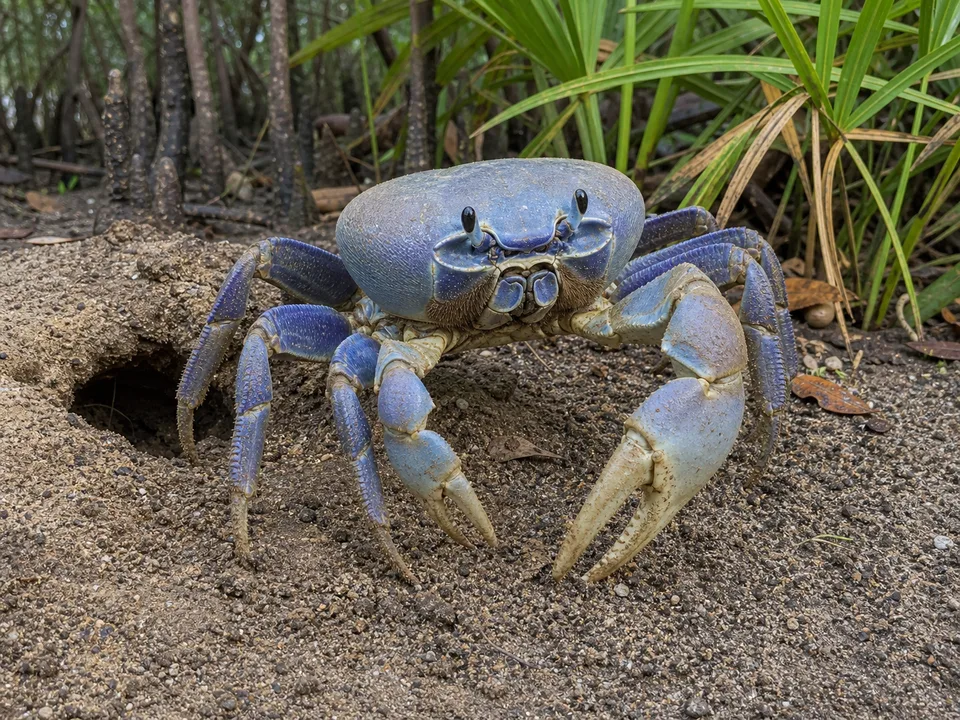
Adult blue land crab beside a sandy coastal burrow

Cardisoma guanhumi

Blue land crab

A large terrestrial crab ranging from pale gray-blue to violet, often with one oversized claw. It lives in burrows above the tide line near coastal hammocks, mangroves, canals, and low-lying yards.

Size
No minimum
Daily limit
20 per person
Season
Closed July 1 through Oct. 31
Eggs
Egg-bearing crabs may not be harvested or stripped of eggs
Legal gear
Hand, landing net, or dip net only. Traps, bleach, and chemical solutions are illegal.

Location rule: Do not harvest from the right-of-way of a federal, state, or county-maintained road or from a Florida state park. Respect all private property.

Check current FWC blue land crab rules →

Also Commonly Seen

Marsh, fiddler, ghost, and spider crabs

Smaller mud, marsh, fiddler, and ghost crabs are common around First Coast shorelines. Spider and decorator crabs occur in saltwater as well. These are different from the primary food-crab fisheries above, and some may fall under Florida’s unregulated-species or marine-life rules.

Never assume “no listed size limit” means unlimited harvest. Confirm the species, location, allowable gear, and current default bag limits before collecting any crab for bait, food, or an aquarium.

FWC unregulated species

Handle & Store Safely

Protect the catch—and your fingers

  • Grip blue crabs from the rear at the base of the swimming legs, or use long tongs.
  • Keep live crabs cool, shaded, damp, and well ventilated; do not submerge them in stagnant fresh water.
  • Wear gloves around shells, oyster bars, trap wire, and bait knives.
  • Release unwanted or prohibited crabs promptly and gently.
  • Check local shellfish and water-quality advisories before eating your catch.

Rules Change

Check FWC before every trip

Limits on this page were checked July 28, 2026. Emergency closures, local restrictions, protected areas, and trap specifications can change.

Open current FWC regulations